
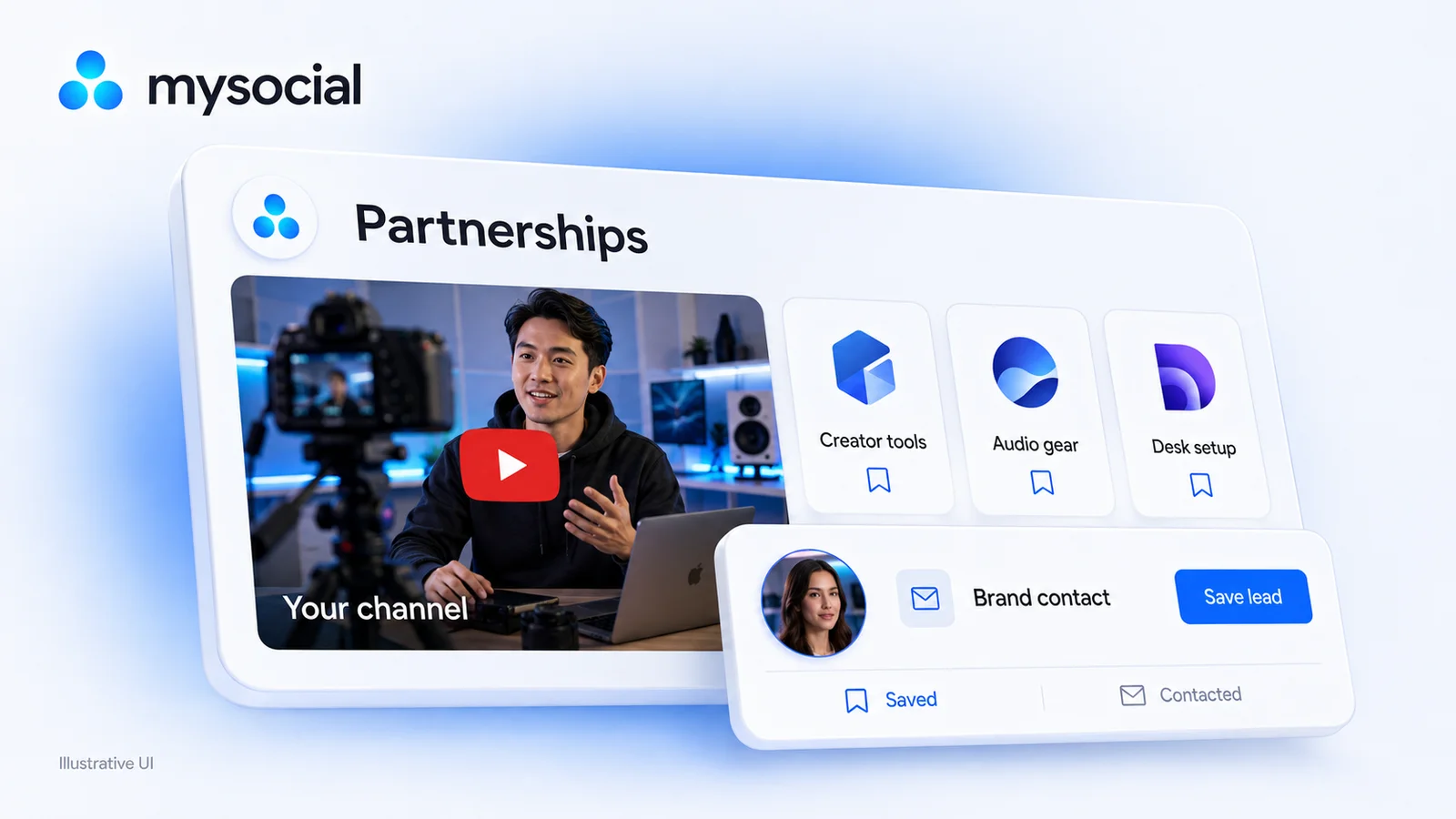
Best YouTube Sponsorship Platforms for Creators
Compare YouTube sponsorship platforms for finding brands and getting booked. See costs, eligibility and the best fit for your channel.

Quick answers
Pick a niche, film with your smartphone (73% of creators do), and upload consistently. You need 1,000 subscribers plus 4,000 watch hours or 10M Shorts views to join the YouTube Partner Program and start earning.
A smartphone with a good camera, a clip-on lapel mic ($15-30), and natural light. Upgrade to a mirrorless camera and shotgun mic when your channel earns enough to justify the investment.
Long-form YouTube vlogs earn $1-30 RPM depending on niche. Shorts pay $0.01-0.06 RPM. Creators using multiple revenue streams (ads, sponsors, affiliates, products) earn 2.8x more than ad-only creators.
Both. Use Shorts for discovery and subscriber growth, long-form for watch time and revenue. Shorts pay 50-100x less per view than long-form, so treat them as a funnel, not a business model.
Over 44% of internet users watch vlogs monthly, and YouTube views surged 76% year-over-year in 2026 (Metricool). Vlogging is not a hobby — it is one of the most scalable creator businesses you can build. But most new vloggers waste months filming content nobody watches because they skip the strategy.
This guide covers the formats that actually perform, the gear that matters (and what does not), and the monetization math behind turning views into revenue.
44%
Of internet users watch vlogs monthly (VloggingPro, 2026)
76%
YouTube view growth year-over-year (Metricool, 2026)
$1-30
RPM range for long-form YouTube content
73%
Of creators use smartphones as primary camera
Not all vlogs perform equally. The format you choose determines your reach, retention, and revenue potential. Here are the five formats ranked by growth efficiency, based on 2025-2026 YouTube data.
Teach viewers how to solve a specific problem. 70-85% average view duration. Converts 5-12% of viewers to paid products vs 0.5-2% for pure entertainment (Clippie, 2026).
Highest RPMTake viewers somewhere they cannot go themselves. High shareability and strong thumbnail click-through rates. Great for affiliate links (gear, hotels, apps).
High shareabilityBefore-and-after journeys — fitness, room makeovers, skill learning. Strong affiliate conversion because viewers want to replicate the result.
Best for affiliatesSlice-of-life content that builds parasocial connection. Strongest audience loyalty but hardest to monetize beyond ads. Requires high upload frequency.
Strongest loyaltyHigh-concept videos built on a premise (“I lived in a cave for 7 days”). Viral potential is highest but production cost and unpredictability make this the riskiest format. Entertainment CPMs are the lowest at $0.01-0.04 RPM for Shorts.
Highest viral potentialSources: Clippie 2026, InfluenceFlow 2026, Metricool YouTube Study 2026
The takeaway: problem-solution and transformation vlogs generate the most revenue per view. Entertainment vlogs get the most views but earn the least per thousand. If you are building a business, lead with educational content and mix in entertainment to stay human. For more on structuring your YouTube content, read our guide on how to grow on YouTube.
The biggest shift in vlogging strategy for 2025-2026 is using Shorts as a discovery engine that feeds your long-form content. Here is why this matters and how to execute it.
Revenue per 1,000 views (RPM)
$0.01–0.06
YouTube Shorts RPM
$1–30
Long-form RPM
The math: Shorts pay 50-100× less per view than long-form. To earn $5K/month from Shorts ads alone, you need 40-100 million monthly views — achievable for roughly 3% of monetized channels (Vozo, 2026). Long-form gets you there at 200K-500K views.
Sources: InfluenceFlow 2026, Vozo YouTube Monetization Playbook 2026
The winning strategy is a funnel: Shorts for reach, long-form for revenue. Post 3-5 Shorts per week clipped from your long-form vlogs. Each Short should end with a reason to watch the full video. This is how creators scale from zero to monetization fastest. For a deep dive on Shorts specifically, see our YouTube Shorts guide.
The vlogging equipment market is projected to hit $1.73 billion by 2034 (OpenPR, 2026). But 73% of creators still use a smartphone as their primary camera. Here is what to buy at each stage.
Step 01
Your phone is enough to start. iPhone 15+ and Samsung Galaxy S24+ shoot 4K with stabilization. Focus your early investment on content quality, not gear.
• Audio — clip-on lapel mic ($15-30) is the single highest-ROI upgrade
• Lighting — natural window light or a $25 ring light
• Stability — a $20 phone tripod with a flexible mount
Total investment: under $75. 68% of creators saw audience growth within 3 months of upgrading just their microphone (InfluenceFlow, 2026).
Step 02
Upgrade when your channel earns enough to justify it — typically after hitting 1K subscribers and YPP monetization.
• Camera — Sony ZV-1 II or Canon EOS R50. Compact, 4K, flip screen, built-in stabilization
• Mic — RODE VideoMicro II (shotgun) or RODE Wireless GO II (lapel)
• Lighting — two-point LED panel setup ($80-150)
This is the gear tier where your production quality visibly separates you from smartphone-only creators.
Step 03
For full-time creators earning $3K+/month. Invest in gear that saves time, not just quality.
• Camera — Sony A7C II or Canon R6 III for low-light and cinematic depth of field
• Audio — RODE PodMic or Shure MV7+ for studio segments
• Software — DaVinci Resolve (free) or Final Cut Pro. AI noise-cancellation tools like Descript
The real upgrade at this level is workflow efficiency: teleprompters, multi-cam setups, and AI-assisted editing.
For a detailed breakdown of starter gear, read our YouTube equipment for beginners guide.
Creators using multiple revenue streams earn 2.8× more than those relying on ads alone (InfluenceFlow, 2026). Here is how the revenue stack works in practice.
Revenue streams for a $5K/month vlogger
Monthly revenue
0$ to 2000$
Revenue stream
Long-form ads
1500$Sponsorships
1500$Affiliates
1000$Shorts ads
500$Products
500$Monthly revenue
Revenue stream
Source: InfluenceFlow 2026, Vozo YouTube Monetization Playbook 2026
Before you earn anything from ads, you need to qualify. There are two paths:
Path B: Shorts route
1,000 subscribers + 10 million Shorts views in 90 days
Best for creators who post daily Shorts
Same monetization features once approved
Path A: Long-form route
1,000 subscribers + 4,000 watch hours in the past 12 months
Best for vloggers who post weekly long-form content
Unlocks full ad revenue, memberships, Super Chat, and Shopping
Ad revenue is the floor, not the ceiling. Here is where vloggers scale income.
Sponsorships — Brands pay $20-50 per 1,000 subscribers for dedicated integrations. A 50K-subscriber vlogger can charge $1,000-2,500 per video. Use a professional media kit to pitch brands with verified analytics. For sponsorship strategy, see how to find YouTube sponsors.
Affiliate marketing — Link products you genuinely use in your descriptions. Problem-solution and transformation vlogs convert 5-12% of viewers vs 0.5-2% for entertainment content (Clippie, 2026). Gear reviews, software tutorials, and “what I use” videos are affiliate goldmines.
Digital products — Courses, presets, templates, and e-books tied to your niche. Educational vloggers earn significantly more per viewer from products than ads.
Memberships and Super Chat — Channel memberships ($0.99-$99.99/month) and Super Chat ($1-500 per message) let your most engaged fans support you directly. These work best for daily vloggers with strong parasocial connection.
For a complete monetization breakdown, read our guide on how to make money on YouTube.
If you are starting from zero, here is exactly what to do in your first week.
Choose one niche and one primary format from the five above. Research 10 successful channels in that niche. Note their titles, thumbnails, and video lengths.
Create your YouTube channel with a clear name, banner, and bio. Order a lapel mic. Set up your filming spot with good natural light. Download a free editor (DaVinci Resolve or CapCut).
Write a script using the hook → body → CTA structure. Film it. Do not aim for perfection — aim for done. Your first 10 videos will teach you more than any guide.
Edit your video down to under 10 minutes. Write a keyword-rich title and description. Design a high-contrast thumbnail. Add chapters and tags. See our YouTube SEO guide for the full optimization checklist.
Publish the long-form video. Clip the 2-3 most compelling moments into Shorts (under 30 seconds each). Post them over the next 3 days to drive traffic back to the full video.
Check your analytics: click-through rate, average view duration, and audience retention graph. Plan your next video based on what the data tells you. Repeat the cycle weekly.
These kill channels faster than bad equipment or low budgets.
What kills channels
Waiting for perfect gear — your smartphone is enough. Viewers care about value, not resolution.
No call to action — if you never ask viewers to subscribe, like, or watch the next video, they will not. Every video needs a CTA.
Ignoring thumbnails — a bad thumbnail kills a great video. High contrast, readable text, expressive face (or clear subject).
Daily uploads without quality — daily vlogging burns creators out and dilutes quality. 1-2 polished videos per week outperforms 7 rushed ones.
Only chasing trends — trend-riding gets views but does not build a subscriber base. Mix trending topics with evergreen content that compounds.
What grows channels
Consistent schedule — one video per week minimum. YouTube's algorithm rewards regularity over sporadic bursts.
Strong hooks — the first 3 seconds determine if viewers stay. Open with the payoff, not the setup.
Keyword-driven titles — write titles people search for. 'How I edit YouTube videos' beats 'My editing workflow vlog #47'.
One niche, deep — the algorithm recommends you to people who watch similar content. Scatter your topics and it cannot categorize you.
Engage in comments — replying to comments in the first hour boosts the video in recommendations. YouTube treats comments as a strong engagement signal.
You now have the format strategy, the equipment roadmap, the monetization math, and a 7-day launch plan. The only thing left is to start filming.
Pick one niche, one format, and commit to 10 videos before judging your results. Your first video will be rough — that is expected. But consistency and iteration beat perfection every time. Use the Mysocial in Claude or ChatGPT to generate hooks, scripts, and thumbnails that save you hours per video.
For more on YouTube strategy, explore our guides on how to create engaging video content, writing YouTube scripts, and the YouTube growth hub.
Your social memory, connected
From finding sponsors to building your media kit to tracking campaign results — Mysocial gives solo creators the infrastructure to turn views into revenue.
Free to start. One channel is enough to begin.
Mysocial connects YouTube, Instagram, TikTok, LinkedIn and Threads to one Content Memory that Claude and ChatGPT can use.
Social Media Growth & Algorithms
Related Posts
Compare YouTube sponsorship platforms for finding brands and getting booked. See costs, eligibility and the best fit for your channel.

Download a free brand deal tracker for YouTube and Instagram. Includes 100 prepared rows, a filled example, follow-up checks, delivery dates and payment balances.
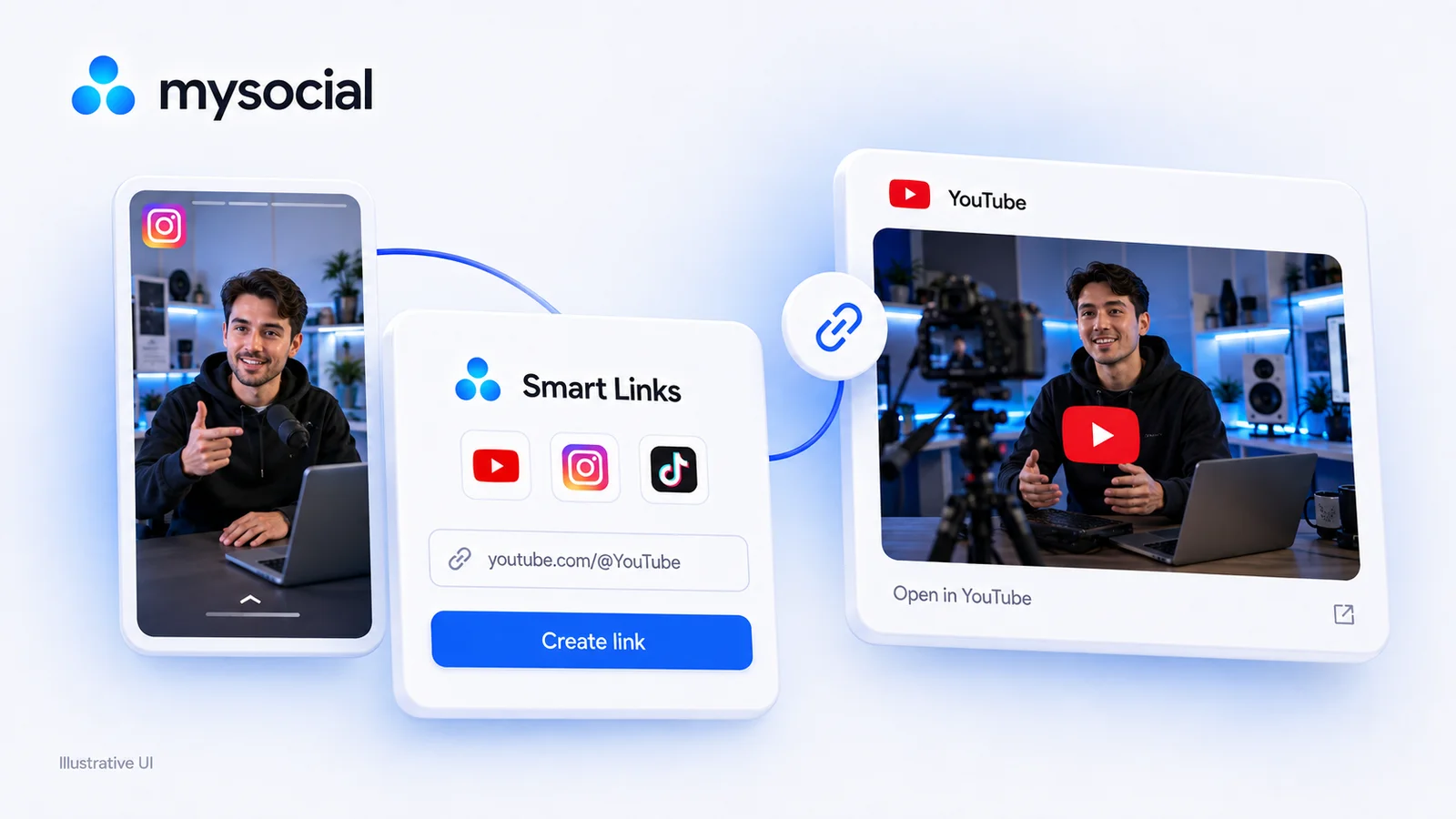
Try a free LinkTwin alternative with a working YouTube link generator. Compare click limits, app-opening behavior and what to check before switching.